All news
Technical Guides
The Science of Shade: How Light Spectrum Shapes Crop Performance
For decades, shade netting has primarily been viewed as a way to reduce sunlight and protect crops from excessive heat and radiation. But modern protected agriculture demands a more sophisticated approach.

For decades, shade netting has primarily been viewed as a way to reduce sunlight and protect crops from excessive heat and radiation. But modern protected agriculture demands a more sophisticated approach.
Not all light is the same—and not all shade nets behave the same.
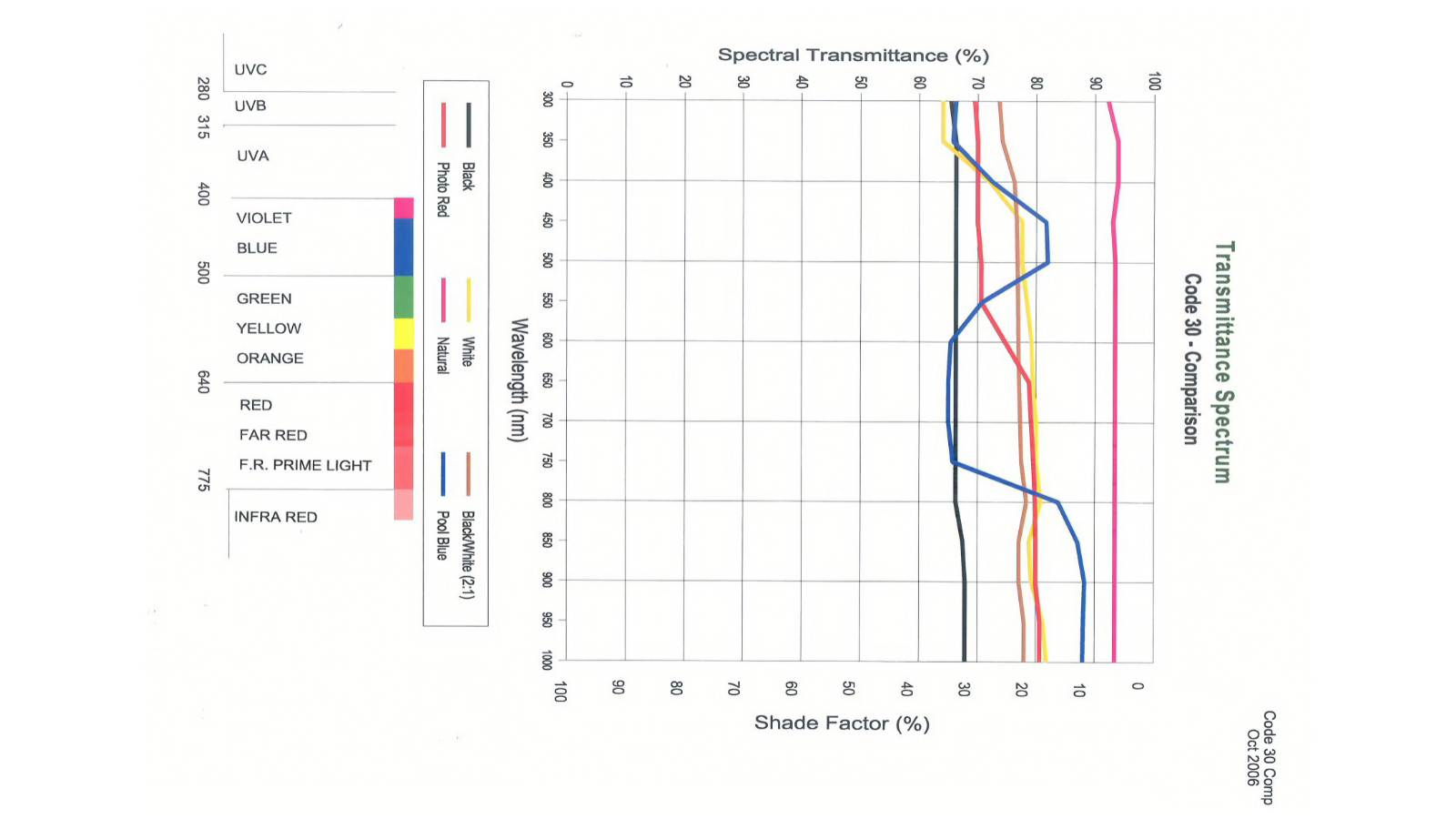
The colour, construction and light-transmission properties of a shade net can influence the quantity, quality and distribution of light reaching the plant canopy. These changes can affect photosynthesis, plant structure, leaf development, flowering, fruit development, transpiration and ultimately crop performance.
Light: More Than Just Intensity
Plants respond to sunlight in two important ways.
Photosynthesis is the process through which plants use light energy to produce sugars—the energy needed for growth and development.
Photomorphogenesis, on the other hand, describes how light acts as an information signal, influencing the way plants grow and develop.
Process | Purpose | What Light Does |
Photosynthesis | Produces energy (sugars) | Light provides the energy source |
Photomorphogenesis | Controls growth and plant shape | Light acts as an information signal |
This means that changing the light environment under a shade net can influence not only how much a plant grows, but also how it grows.
Red Shade Nets – Supporting Growth and Development
Red shade nets allow a higher proportion of red wavelengths to pass through. Red light is particularly important for photosynthetic activity and can support strong plant growth under partial shade.
Potential benefits include:
Enhanced photosynthesis
Stimulated vegetative growth
Improved flowering and fruit development
Red-spectrum management can therefore be particularly valuable where the objective is to maintain vigorous growth while controlling excessive solar radiation.
Blue Shade Nets – Compact, Strong Plant Growth
Blue light plays an important role in regulating plant structure and leaf development.
A blue shade net changes both the intensity and spectral composition of light reaching the crop, potentially encouraging a more compact and robust growth habit.
Key benefits include:
Compact, stronger plant growth
Improved leaf development
Controlled plant architecture
This can be particularly valuable where excessive vegetative elongation needs to be managed.
White Shade Nets – Maximising Light Diffusion
White shade netting behaves differently from darker nets. Rather than simply absorbing a large proportion of incoming radiation, white filaments can reflect and diffuse light.
The result can be a more evenly distributed light environment throughout the crop canopy.
Benefits include:
Excellent light diffusion
Improved crop uniformity
Better distribution of light within the canopy
This is important because leaves positioned deeper within the canopy may otherwise receive insufficient light.
Clear Shade Nets – Reducing Light Without Significantly Changing the Spectrum
A clear shade net, without colour pigments, behaves differently again.
Rather than significantly modifying the spectrum, it primarily reduces the intensity of incoming light while retaining a more natural spectral composition.
Its key advantage is therefore:
Light reduction without significant spectral change.
This makes clear constructions an attractive option where growers want to manage solar intensity and microclimate while maintaining a natural light spectrum.
Black + Clear – A Balanced Approach
Combining black and clear filaments creates a different shading environment by combining the properties of both materials.
The result is:
Balanced light reduction
Improved light distribution
Reduced heat stress
A more natural spectral environment than strongly coloured constructions
This approach can provide growers with a balance between solar protection and maintaining useful light within the crop canopy.
Diffused Light: Making Better Use of the Light You Have
An important consideration in protected agriculture is not simply how much light reaches the crop, but where that light goes.
Direct sunlight can be concentrated on the upper leaves of a crop canopy, while leaves lower down may remain relatively shaded.
Diffused light can penetrate deeper into the canopy, allowing more leaves to participate in photosynthesis.
As a result, a diffused-light environment can sometimes improve crop performance even when total incoming light is slightly reduced.
In simple terms:
Shade nets optimise light distribution for the plant canopy.
Shade Also Changes the Crop Microclimate
The benefits of shade extend beyond light management.
By modifying solar radiation, shade netting can influence:
Temperature
Humidity
Air movement
Transpiration
Respiration
Plant water use
Heat stress
Reducing excessive solar radiation can reduce the thermal load on plants and influence the rate at which water is lost through transpiration.
The objective is therefore not simply to block sunlight, but to create a more favourable environment in which the crop can perform efficiently.
Choosing the Right Shade for the Right Crop
Different crops—and even different growth stages of the same crop—can have different light requirements.
The right shade net can be selected according to the desired combination of:
Light intensity + light spectrum + diffusion + microclimate control.
In simplified terms:
Red → supports vegetative growth (longer internodes), flowering and fruit development
Blue → encourages compact, sturdy plant growth
White → maximises diffusion and crop uniformity
Clear → reduces light intensity while maintaining a more natural spectrum
Black → primarily reduces light intensity
Black + Clear → provides balanced light reduction and distribution
There is no single shade solution that is ideal for every crop, climate or production objective.
The right shade is the shade engineered for the crop.
Knittex SpectraNet Premium – Engineered Around the Crop
With Knittex SpectraNet Premium, growers can select from approximately 4% to 95% light transmission, with net construction and colour engineered to suit specific crop requirements.
Whether the objective is to:
Protect sensitive seedlings
Reduce heat and solar stress
Manage plant architecture
Improve light distribution
Support flowering and fruit development
Maintain crop uniformity
Or optimise the growing environment
SpectraNet Premium gives growers greater control over the light environment.
Because the future of shade netting is not simply about how much sunlight you keep out.
It is about understanding the light you let in.
Knittex SpectraNet Premium
Control sunlight. Reduce stress. Optimise growth.
Setting the World Standard in Shade Innovation.